
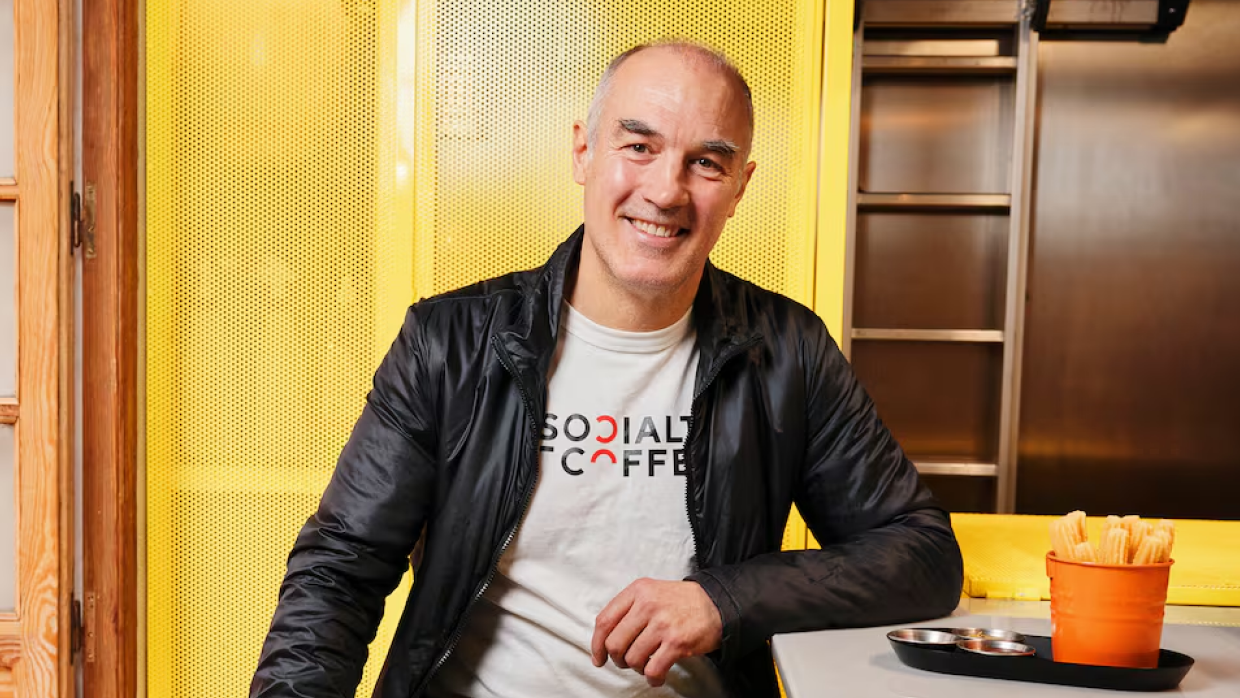
Marcos Gilligan offers a new life to Palestinian, Senegalese, and Ukrainian asylum seekers in his Madrid café
Although the business is not going through its best moment, Socialty Coffee by Chirusa has already gained attention in several media outlets. Coverage has highlighted the quality of its churros made with organic flours, its specialty coffees and single-origin chocolates, as well as its proximity to Madrid’s Retiro Park. Marcos Gilligan, who has extensive professional experience in food companies, initially believed that differentiation and the quality of his gastronomic offering would be enough to attract customers. Until he realized it was time to tell—and promote—his true and only reason for existing: providing jobs for refugees.
Today, five people work in this small coffee and chocolate shop. At one point there were nine, although reality eventually adjusted the staff: Astou, from Senegal, miraculously rescued in Canary Islands waters when the boat she was traveling on capsized while attempting to reach the coast; Motasem, a Palestinian who six years ago decided to seek a new horizon far from armed conflict; Amparo, from Colombia, who fled the rural area near Cali where she lived to escape extortion and threats from guerrilla groups; Maria, from Armenia, threatened by political and social conflicts; and Liza, from Ukraine…
After leaving one of the major food companies where he had worked, Gilligan felt the time for change had come. “I don’t want to do this anymore,” he said. He sold his house in Argentina—where he was born, in Córdoba, in 1971—and secured enough money and time to plan his new project, with one non-negotiable goal: that it would have a social impact.
A Catholic upbringing in a well-off family, with a strong inclination toward helping others, along with an earlier opportunity for real intervention through the business world—donating food to an African community that was about to be discarded due to a risky “best before” date—reinforced his commitment to what he calls “a capitalism with the capacity to influence.” His discourse makes it clear that he is by no means a utopian revolutionary seeking to overthrow the system. Marcos Gilligan believes in capitalism, but also in its responsibility to have a social impact. “I’m not the champion of empathy. I believe capitalism should be more humane, and that it can be changed from within,” he maintains.
A small rental space at number 5 on Calle de Castelló gave him the opportunity to launch his project. He would have liked to open an ice cream shop, but it ended up being a churros café because that had been the previous business in the space, and bureaucracy advised maintaining the same activity. He contacted CEAR, the Spanish Commission for Refugee Aid, explained his intentions, and did not ask for specific profiles—only that they send whoever needed it most. He opened on June 3, 2022, initially under the name Chirusa, an Argentine word describing a woman of vulgar behavior and also the title of a well-known tango. And that is how it has remained.
Having a job while an asylum application is being processed allows applicants to achieve enough stability to claim social integration when a decision arrives, even if it is negative. In this way, Socialty Coffee by Chirusa has changed the lives of this group of refugees: it has not only taken them off the streets, but also given them the opportunity to work while learning Spanish.
At the same time, Gilligan has built a kind of collaborative community around Socialty Coffee, based on a commitment to local sourcing and artisanal products. The flowers decorating the café are supplied weekly by Lily, a florist located just 100 meters away; the pastries they do not make themselves come from artisanal projects such as Clan Obrador and Cientotreinta Grados; the kombucha, also artisanal, comes from Bioma; and the specialty coffee is supplied by Hola Coffee, which has one of its locations half a kilometer away and also runs a training center. The neighboring restaurant, Arúgula, lends its space to accommodate customers who want to enjoy chocolate with churros.
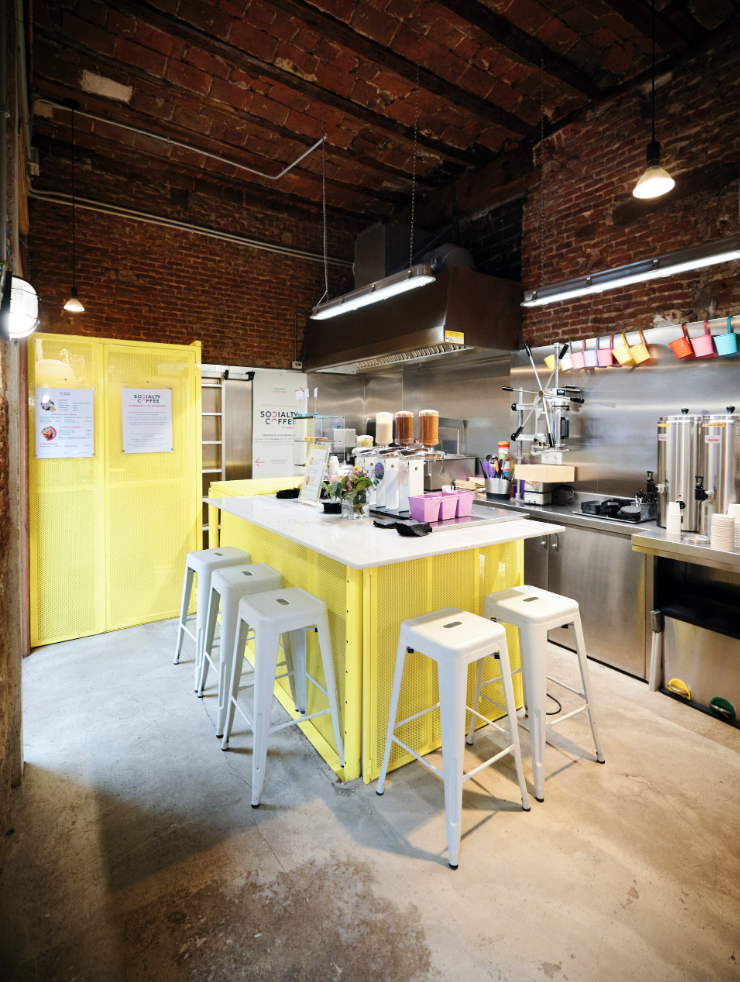
Other practices, such as the use of biodegradable, plastic-free packaging, follow the same philosophy—although some are costly. Initially, Socialty Coffee (then simply Chirusa) decided to give away a stainless-steel thermos to anyone who ordered a liter of hot chocolate, encouraging them to return with it and reuse it for future orders. The investment amounted to €1,800; 120 thermoses were distributed; but only about 15 customers ever returned to refill them.
Resigned to the idea that Socialty Coffee by Chirusa will hardly become his main source of income, Gilligan has begun to look for ways to generate revenue through other means. Aware that closing is not an option, he gets up early every day to place once again at the door the sign reminding passersby that Socialty Coffee by Chirusa is “a space with purpose, run and managed by refugees.” “Thank you,” the sign continues, “for helping to create a positive social impact and foster inclusion.” By the way, the Belgian chocolate with churros is exquisite.
